HỒ SƠ ĐỀ THI CHUẨN IN A4 • MÃ ĐỀ #6802
TEMPLATE: DETHICHUAN-A4-V2DETHICHUAN#6802
Đề Thi Thử Tốt Nghiệp THPT Tiếng Anh 2026 Sở GD&ĐT Hà Tĩnh (Mã Đề 0201)
Câu 1: a. Paul: Don't worry. I'll send you the notes after class. b. Sarah: Thank you! That ...
A. Đáp án AB. Đáp án BC. Đáp án CD. Đáp án D
40 CÂUCÓ ĐÁP ÁN
PDF CHUẨN IN A4•THPT
Đề Thi Thử Tốt Nghiệp THPT Tiếng Anh 2026 Sở GD&ĐT Hà Tĩnh (Mã Đề 0201)
de-thi-thu-tot-nghiep-thpt-tieng-anh-2026-so-gddt-ha-tinh-ma-de-0201-dethichuan.pdf
Số lượng
40 câu
Thời gian
50 phút
Phụ lục cuối đề
Đáp án & Giải
Bản in được dàn trang theo mẫu chuẩn của dethichuan.com
Số lượng
40 câu
Thời gian
50 phút
Phụ lục
Đáp án & Giải
Đang dàn trang A4 & kết xuất 40 câu hỏi...00:10
TÀI TRỢ MÁY CHỦSPONSORED
💡 Hướng dẫn lưu tệp: Khi hộp thoại bản in A4 mở ra, tại mục Máy in / Destination, chọn Save as PDF (Lưu dưới dạng PDF) để lưu tệp về máy.
HỆ THỐNG ĐỀ THI TRỰC TUYẾN DETHICHUAN.COM ĐỀ THI CHÍNH THỨC (Đề thi gồm có 40 câu) | Đề Thi Thử Tốt Nghiệp THPT Tiếng Anh 2026 Sở GD&ĐT Hà Tĩnh (Mã Đề 0201) Bài thi / Phân loại: THPT Thời gian làm bài: 50 phút, không kể thời gian phát đề Mã đề thi: 6802 |
Họ, tên thí sinh:Số báo danh:
Câu 1:
a. Paul: Don't worry. I'll send you the notes after class.
b. Sarah: Thank you! That would be great.
c. Sarah: I'm sorry I missed today's lesson. Could you help me with the notes?
b. Sarah: Thank you! That would be great.
c. Sarah: I'm sorry I missed today's lesson. Could you help me with the notes?
A.
b – a – c
B.
c – a – b
C.
c – b – a
D.
b – c – a
Câu 2:
a. Lan: That's a good idea. I've been trying to eat more vegetables and cut down on sugar lately.
b. Lan: You seem much more energetic these days. Have you changed your routine?
c. Minh: Exactly. Regular exercise and a balanced diet really make a difference.
d. Minh: Yes, I've started going to the gym three times a week and sleeping earlier.
e. Lan: I totally agree. Staying healthy requires both discipline and consistency.
A.
b – a – d – c – e
B.
d – b – a – e – c
C.
e – b – a – d – c
D.
b – d – a – c – e
Câu 3:
Dear Parents,
a. Should you have any questions regarding the revised fee structure, please contact the school office for further clarification.
b. The updated tuition rates will take effect from the beginning of the next academic term in January.
c. We understand that this adjustment may require careful consideration, and we appreciate your continued support.
d. Due to rising operational costs and improvements in educational facilities, the school will be implementing a revised tuition policy.
e. We are writing to inform you of an important update concerning the school's tuition fees.
Yours faithfully,
Greenfield International School
A.
d – b – e – a – c
B.
e – d – b – a – c
C.
d – e – b – c – a
D.
e – b – a – d – c
Câu 4:
a. In the end, I came to see that leaving my comfort zone had been the most valuable part of the experience.
b. These challenges became clear when navigating unfamiliar streets, sampling local dishes and dealing with a different dialect proved more demanding than I had anticipated.
c. Having to handle everything alone, without the support of friends or family, left me feeling slightly uneasy.
d. In retrospect, the journey not only strengthened my independence but also made me more confident in unfamiliar situations.
e. During the summer holiday, I chose to travel alone to a small coastal town, expecting nothing more than a peaceful break.
A.
e – b – c – a – d
B.
b – c – e – a – d
C.
b – e – c – d – a
D.
e – c – b – a – d
Câu 5:
a. Over the past few years, the organisation has struggled with communication gaps and declining employee morale.
b. To enhance collaboration, the company introduced regular team-building workshops and cross-departmental projects.
c. As a result, overall productivity improved, and employees reported higher levels of job satisfaction.
d. These initiatives encouraged staff members to share ideas more openly and develop stronger professional relationships.
e. Recognising these challenges, senior managers decided to implement a comprehensive strategy to strengthen teamwork across the company.
A.
e – b – a – c – d
B.
a – b – e – d – c
C.
e – a – b – c – d
D.
a – e – b – d – c
Airport Delays and Cancellations: What Travellers Should Know
Read the following leaflet and mark the letter A, B, C, or D on your answer sheet to indicate the option that best fits each of the numbered blanks from 6 to 11.
Airport Delays and Cancellations: What Travellers Should Know
Flight disruptions are becoming more common in the United States. Weather conditions, staffing shortages and technical problems can (6) ___________________________ significant delays or cancellations. Passengers are advised to check airline updates regularly and stay informed about any schedule (7) _________.
Travellers should arrive early at the airport (8) ______________ unexpected security procedures may extend waiting times. Airlines are responsible for offering assistance under a (9) ______________________ des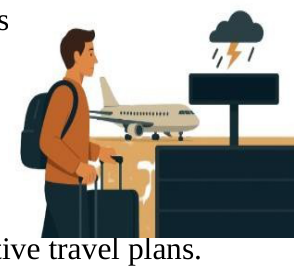 affected passengers.
To reduce inconvenience:
• Keep essential items in a carry-on bag.
• Contact airline staff to (10) _______________ a compensation claim if your flight is cancelled for reasons within the airline's control.
• Check the (11) _______________ of flights cancelled on your route before making alternative travel plans.
Airport Delays and Cancellations: What Travellers Should Know
Flight disruptions are becoming more common in the United States. Weather conditions, staffing shortages and technical problems can (6) ___________________________ significant delays or cancellations. Passengers are advised to check airline updates regularly and stay informed about any schedule (7) _________.
Travellers should arrive early at the airport (8) ______________ unexpected security procedures may extend waiting times. Airlines are responsible for offering assistance under a (9) ______________________ des
affected passengers.To reduce inconvenience:
• Keep essential items in a carry-on bag.
• Contact airline staff to (10) _______________ a compensation claim if your flight is cancelled for reasons within the airline's control.
• Check the (11) _______________ of flights cancelled on your route before making alternative travel plans.
Câu 6:
Weather conditions, staffing shortages and technical problems can (6) _______ significant delays or cancellations.
A.
give rise to
B.
give up on
C.
give way to
D.
result from
Câu 7:
Passengers are advised to check airline updates regularly and stay informed about any schedule (7) _______.
A.
settlements
B.
enclosures
C.
adjustments
D.
possessions
Câu 8:
Travellers should arrive early at the airport (8) _______ unexpected security procedures may extend waiting times.
A.
and
B.
but
C.
so
D.
because
Câu 9:
Airlines are responsible for offering assistance under a (9) _______ ... affected passengers.
A.
passenger assistance policy
B.
assistance passenger policy
C.
passenger policy assistance
D.
policy passenger assistance
Câu 10:
Contact airline staff to (10) _______ a compensation claim if your flight is cancelled for reasons within the airline's control.
A.
postpone
B.
replace
C.
file
D.
undergo
Câu 11:
Check the (11) _______ of flights cancelled on your route before making alternative travel plans.
A.
number
B.
rate
C.
amount
D.
level
Mobile usability passage (Questions 12–19)
Read the following passage and mark the letter A, B, C or D on your answer sheet to indicate the best answer to each of the following questions from 12 to 19.
As smartphones increasingly dominate online activity, improving mobile usability has become a strategic priority for digital designers. Compared with desktop interfaces, mobile environments present constraints due to limited screen space and touch-based interaction. These conditions require layouts that minimise distraction, highlight essential functions and help users complete tasks efficiently without excessive cognitive effort.
A common problem in mobile interface design is visual clutter. When too many buttons, images or text blocks compete for attention, users may struggle to navigate effectively or interpret information accurately. Establishing a clear visual hierarchy, maintaining consistent design patterns and ensuring readable typography allow users to process content more smoothly. Removing redundant elements and simplifying structures can significantly enhance clarity while preserving functional balance and interface consistency.
Effective navigation is essential for maintaining usability across mobile platforms. Since small screens cannot accommodate complex menu systems, designers must adopt simplified and logically organised structures. Features such as compact icons, bottom navigation bars and gesture-based commands are widely used to facilitate quicker interaction. However, these solutions must be carefully designed, as poorly labelled or hidden functions may confuse users and reduce overall satisfaction.
Performance and responsiveness also shape user experience. Mobile users often access information in short sessions and expect immediate results. When a page loads slowly or relies heavily on visual effects, users may abandon it more quickly, weakening long-term engagement. Technical optimisation, including image compression, efficient coding and adaptive design, supports smoother performance across devices and varying network conditions.
Finally, user testing remains crucial in mobile design. By observing real usage patterns, designers can identify obstacles that theoretical assumptions overlook. They can then adjust layouts and refine navigation flows to align better with user expectations. In a competitive digital marketplace, usability functions not merely as an enhancement but as a fundamental requirement for sustained growth.
(Adapted from https://consumersearch.com)
Câu 12:
Which of the following is NOT mentioned as a factor affecting mobile usability?
A.
Hardware storage capacity
B.
Touch-based interaction
C.
Performance and responsiveness
D.
Limited screen space
Câu 13:
The word constraints in paragraph 1 can be best replaced by _______.
A.
innovations
B.
advantages
C.
adjustments
D.
limitations
Câu 14:
The word redundant in paragraph 2 is OPPOSITE in meaning to _______.
A.
unnecessary
B.
excessive
C.
innovative
D.
essential
Câu 15:
The word it in paragraph 4 refers to _______.
A.
a page
B.
a technical optimisation
C.
a long-term engagement
D.
a user behaviour
Câu 16:
Question 16. Which of the following best paraphrases the underlined sentence in paragraph 5?
A.
In competitive digital markets, usability has become essential rather than simply an additional improvement.
B.
In competitive digital markets, usability can enhance platforms but is not always necessary for growth.
C.
In competitive digital markets, platform success often results from marketing instead of improvements.
D.
In competitive digital markets, sustained growth depends mainly on innovative visual design strategies.
Câu 17:
Question 17. Which of the following is TRUE according to the passage?
A.
User testing guarantees error-free interface design.
B.
Hidden or unclear navigation elements may decrease user satisfaction.
C.
Visual effects always strengthen long-term engagement.
D.
Complex menu systems are suitable for small mobile screens.
Câu 18:
Question 18. Which paragraph discusses the importance of reducing unnecessary design elements?
A.
Paragraph 3
B.
Paragraph 4
C.
Paragraph 2
D.
Paragraph 1
Câu 19:
Question 19. Which paragraph refers to technical strategies for improving system performance?
A.
Paragraph 2
B.
Paragraph 5
C.
Paragraph 4
D.
Paragraph 3
Edinburgh Science Festival (Questions 20-25)
Read the following advertisement and mark the letter A, B, C, or D on your answer sheet to indicate the option that best fits each of the numbered blanks from 20 to 25.
Edinburgh Science Festival
The Edinburgh Science Festival is an annual event (20) ___________celebrates scientific discovery and innovation. Held each spring, the festival offers numerous exhibitions, workshops and interactive activities designed to (21) ______ interest among people of all ages.
Visitors are encouraged to take part in hands-on experiments and discussions (22) __________by scientists and researchers. Although participants may have little scientific background, the activities are designed to be accessible and engaging.
The festival also highlights the importance of scientific (23) ____________in modern society, especially in addressing global challenges.
Many events rely on collaboration between universities, schools and research organisations.
(24) ____________ the festival to receive greater support from schools and local communities, it would have an even wider impact. Some schools already organise regular science-related activities for young people, and (25) _____schools may follow if more support is available.
(Adapted from https://www.earthday.org)
Câu 20:
Question 20.
A.
whose
B.
who
C.
which
D.
whom
Câu 21:
Question 21.
A.
reduce
B.
ignore
C.
create
D.
cancel
Câu 22:
Question 22.
A.
led
B.
lead
C.
are led
D.
leading
Câu 23:
Question 23.
A.
literate
B.
illiteracy
C.
literately
D.
literacy
Câu 24:
Question 24.
A.
Unless
B.
Should
C.
Had
D.
Were
Câu 25:
Question 25.
A.
another
B.
others
C.
other
D.
the other
Brownwashing passage (Questions 26-30)
Read the following passage and mark the letter A, B, C or D on your answer sheet to indicate the option that best fits each of the numbered blanks from 26 to 30.
While greenwashing has received significant public attention, brownwashing remains less widely recognised. It occurs when companies intentionally minimise or obscure their genuine environmental progress in public communication. (26) ___. As a
One reason for this behaviour is the increasing pressure placed on companies to meet ambitious sustainability targets. (27) __________. In such situations, organisations may prefer to avoid strong claims altogether rather than draw attention to commitments they may struggle to fulfil. This cautious approach can be particularly common in highly competitive industries.
However, brownwashing can also create unintended consequences, (28) ____________. When companies fail to communicate their achievements clearly, stakeholders may struggle to identify which firms are genuinely making progress.
Another concern is that inconsistent communication practices make comparison difficult. (29) ____________, those that communicate more clearly may gain an advantage, regardless of their actual environmental performance.
To address these challenges, experts suggest that improving both transparency and consistency is essential. The key issue is (30) ________.
(Adapted from https://news.umich.edu)
Câu 26:
Question 26.
A.
This may seem counterintuitive, as businesses are generally expected to highlight their achievements
B.
This is often driven by companies’ desire to improve their image through environmental communication
C.
In addition, sustainability reporting has become an important tool for corporate communication
D.
For this reason, many firms attempt to expand their environmental campaigns to reach wider audiences
Câu 27:
Question 27.
A.
In many cases, companies that fail to live up to these expectations may face criticism and reputational damage
B.
As a result, companies invest more resources in promoting their environmental achievements to attract support
C.
For example, some organisations prioritise internal improvements before sharing their results publicly
D.
In addition, sustainability reporting helps firms communicate their long-term strategies more clearly to investors
Câu 28:
Question 28.
A.
leaving responsible firms less recognised for their real environmental efforts
B.
reflecting differences in standards across sectors and reporting systems
C.
reinforcing the role of sustainability reporting in corporate communication
D.
making sustainability reporting less common in competitive industries
Câu 29:
Question 29.
A.
Since corporate communication strategies play an important role in shaping public perception
B.
When companies adopt different ways of presenting their environmental results in reports
C.
Because environmental reports are often used to support broader corporate messaging
D.
Although many organisations aim to improve transparency in sustainability communication
Câu 30:
Read the following passage and mark the letter A, B, C or D on your answer sheet to indicate the option that best fits each of the numbered blanks from 26 to 30.
While greenwashing has received significant public attention, brownwashing remains less widely recognised. It occurs when companies intentionally minimise or obscure their genuine environmental progress in public communication. (26) ______. One reason for this behaviour is the increasing pressure placed on companies to meet ambitious sustainability targets. (27) ______. In such situations, organisations may prefer to avoid strong claims altogether rather than draw attention to commitments they may struggle to fulfil. This cautious approach can be particularly common in highly competitive industries.
However, brownwashing can also create unintended consequences, (28) ______. When companies fail to communicate their achievements clearly, stakeholders may struggle to identify which firms are genuinely making progress.
Another concern is that inconsistent communication practices make comparison difficult. (29) ______, those that communicate more clearly may gain an advantage, regardless of their actual environmental performance.
To address these challenges, experts suggest that improving both transparency and consistency is essential. The key issue is (30) ______.
(Adapted from https://news.umich.edu)
Question 30. The key issue is (30) ______.
A.
whether companies are communicating accurately or creating misleading impressions selectively
B.
the extent to which environmental policies influence business decisions in competitive markets
C.
how companies can strengthen their reputation through clearer environmental communication
D.
why sustainability reporting has become increasingly important in modern corporate practices
Read the following passage and mark the letter A, B, C or D on your answer sheet to indicate the best answer to each of the following questions from 31 to 40.
For more than fifteen years, environmental organisations, scientists and Indigenous communities campaigned for stronger protection of the High Seas – the vast areas of ocean beyond national jurisdiction. These waters, covering nearly half of the planet, had long remained largely unregulated and vulnerable to intensive resource exploitation. In early 2026, their efforts culminated in the entry into force of the Global Ocean Treaty, creating a new legal framework for international marine governance.
Before the Treaty, less than one percent of the High Seas was fully or highly protected. Industrial fishing fleets operated with minimal restrictions, and proposals for deep-sea mining raised concerns about irreversible ecological damage and long-term habitat degradation. [I] By establishing a formal process to designate marine protected areas, the Treaty provides governments with tools to conserve biodiversity on a scale not previously possible in international waters.
Supporters argue that protecting the High Seas is essential not only for marine life but also for climate stability. Oceans absorb vast amounts of carbon dioxide and regulate global temperatures. Moreover, billions of people depend on healthy marine ecosystems for food security and economic livelihoods. In this context, ocean conservation is increasingly viewed as central to sustainable development rather than a purely environmental objective.
Nevertheless, adoption of the Treaty did not occur without resistance. [II] Some governments were initially reluctant to accept binding obligations that might limit industrial expansion. Negotiations required compromise, and implementation will depend on continued political will and institutional coordination. Under the agreement, proposals for protected areas must be based on scientific evidence and involve consultation with affected communities, ensuring legitimacy and accountability.
World leaders have committed to protecting 30 percent of the world's oceans by 2030 – the "30x30" goal. [III] Achieving this target will demand consistent monitoring, transparent reporting and meaningful enforcement. Past environmental agreements demonstrate that ambitious pledges alone do not automatically produce measurable results.
[IV] The Global Ocean Treaty therefore represents both a diplomatic achievement and a test of global commitment. Its ultimate impact will depend on whether governments transform negotiated promises into sustained protection for marine ecosystems.
(Adapted from https://www.greenpeace.org.uk)
Câu 31:
Question 31. According to paragraph 1, the coming into force of the Global Ocean Treaty can best be seen as the result of
A.
economic incentives generated by expanding marine industries worldwide
B.
a sudden rise in international disputes over ocean resource exploitation
C.
a rapid shift in government policy triggered by recent scientific discoveries
D.
prolonged and coordinated pressure from environmental and scientific advocates
Câu 32:
Question 32. Which of the following is NOT mentioned as a reason for protecting the High Seas?
A.
Maintaining planetary climate stability
B.
Supporting coastal economic livelihoods
C.
Preserving global marine biodiversity
D.
Expanding international trade networks
Câu 33:
Question 33. The word their in paragraph 1 refers to _______.
A.
environmental groups, scientists and Indigenous communities
B.
environmental advocacy organisations
C.
national governments in treaty negotiations
D.
scientific research institutions
Câu 34:
Question 34. The word culminated in paragraph 1 mostly means _______.
A.
accelerated
B.
initiated
C.
resulted in
D.
complicated
Câu 35:
Question 35. Which of the following best summarises paragraph 2?
A.
Rising concern over deep-sea mining encouraged stronger international regulation of marine activities.
B.
Some protections in international waters existed, but they remained too limited to prevent ecological damage.
C.
Industrial exploitation in the High Seas revealed regulatory failings that the Treaty was designed to address.
D.
Weak protection and growing exploitation in the High Seas highlighted the need for the Treaty framework.
Câu 36:
Question 36. Which of the following best paraphrases the underlined sentence in paragraph 3?
A.
Efforts to safeguard marine ecosystems are mainly promoted for environmental reasons, while their developmental role remains uncertain.
B.
The protection of marine ecosystems is increasingly discussed within sustainability debates, yet still treated chiefly as an ecological issue.
C.
Beyond environmental considerations, protecting the oceans is increasingly regarded as integral to long-term social and economic progress.
D.
Policies supporting marine protection are increasingly linked to economic development, though environmental priorities are becoming less central.
Câu 37:
Question 37. According to paragraph 4, one challenge during negotiations was that some governments _______.
A.
withdrew from multilateral discussions entirely
B.
rejected community involvement requirements
C.
resisted accepting legally binding obligations
D.
opposed formal scientific consultation processes
Câu 38:
Question 38. It can be inferred from the passage that the Treaty's effectiveness will hinge on _______.
A.
legal adoption automatically producing ecological recovery
B.
preventing economic expansion in marine industries altogether
C.
the 30x30 pledge guaranteeing universal compliance
D.
national priorities aligning with collective enforcement mechanisms
Câu 39:
Question 39. Where in the passage does the following sentence best fit?
"Such hesitation illustrates the tension between environmental ambition and economic calculation."
"Such hesitation illustrates the tension between environmental ambition and economic calculation."
A.
[II]
B.
[I]
C.
[III]
D.
[IV]
Câu 40:
Question 40. Which of the following best summarises the passage?
A.
International marine agreements often project ambitious goals but risk remaining symbolic unless backed by rigorous enforcement and political commitment.
B.
Structural challenges in regulating international waters continue to undermine attempts at comprehensive ocean protection, despite diplomatic progress.
C.
The Treaty is a landmark achievement, yet its credibility depends on governments translating negotiated promises into sustained ecological protection.
D.
Efforts to conserve the High Seas reveal persistent tensions between environmental imperatives and economic expansion, complicating global governance.
---------------- HẾT ----------------
(Thí sinh không được sử dụng tài liệu. Cán bộ coi thi không giải thích gì thêm)
BẢNG ĐÁP ÁN VÀ HƯỚNG DẪN GIẢI CHI TIẾT
Đề Thi Thử Tốt Nghiệp THPT Tiếng Anh 2026 Sở GD&ĐT Hà Tĩnh (Mã Đề 0201) — Mã đề: 6802 • Nguồn: dethichuan.com
| Câu | 1 | 2 | 3 | 4 | 5 | 6 | 7 | 8 | 9 | 10 |
|---|---|---|---|---|---|---|---|---|---|---|
| Đáp án | — | — | — | — | — | — | — | — | — | — |
| Câu | 11 | 12 | 13 | 14 | 15 | 16 | 17 | 18 | 19 | 20 |
|---|---|---|---|---|---|---|---|---|---|---|
| Đáp án | — | — | — | — | — | — | — | — | — | — |
| Câu | 21 | 22 | 23 | 24 | 25 | 26 | 27 | 28 | 29 | 30 |
|---|---|---|---|---|---|---|---|---|---|---|
| Đáp án | — | — | — | — | — | — | — | — | — | — |
| Câu | 31 | 32 | 33 | 34 | 35 | 36 | 37 | 38 | 39 | 40 |
|---|---|---|---|---|---|---|---|---|---|---|
| Đáp án | — | — | — | — | — | — | — | — | — | — |
HƯỚNG DẪN GIẢI CHI TIẾT TỪNG CÂU
Câu 1 (Chọn —):Đáp án đúng là —.
Câu 2 (Chọn —):Đáp án đúng là —.
Câu 3 (Chọn —):Đáp án đúng là —.
Câu 4 (Chọn —):Đáp án đúng là —.
Câu 5 (Chọn —):Đáp án đúng là —.
Câu 6 (Chọn —):Đáp án đúng là —.
Câu 7 (Chọn —):Đáp án đúng là —.
Câu 8 (Chọn —):Đáp án đúng là —.
Câu 9 (Chọn —):Đáp án đúng là —.
Câu 10 (Chọn —):Đáp án đúng là —.
Câu 11 (Chọn —):Đáp án đúng là —.
Câu 12 (Chọn —):Đáp án đúng là —.
Câu 13 (Chọn —):Đáp án đúng là —.
Câu 14 (Chọn —):Đáp án đúng là —.
Câu 15 (Chọn —):Đáp án đúng là —.
Câu 16 (Chọn —):Đáp án đúng là —.
Câu 17 (Chọn —):Đáp án đúng là —.
Câu 18 (Chọn —):Đáp án đúng là —.
Câu 19 (Chọn —):Đáp án đúng là —.
Câu 20 (Chọn —):Đáp án đúng là —.
Câu 21 (Chọn —):Đáp án đúng là —.
Câu 22 (Chọn —):Đáp án đúng là —.
Câu 23 (Chọn —):Đáp án đúng là —.
Câu 24 (Chọn —):Đáp án đúng là —.
Câu 25 (Chọn —):Đáp án đúng là —.
Câu 26 (Chọn —):Đáp án đúng là —.
Câu 27 (Chọn —):Đáp án đúng là —.
Câu 28 (Chọn —):Đáp án đúng là —.
Câu 29 (Chọn —):Đáp án đúng là —.
Câu 30 (Chọn —):Đáp án đúng là —.
Câu 31 (Chọn —):Đáp án đúng là —.
Câu 32 (Chọn —):Đáp án đúng là —.
Câu 33 (Chọn —):Đáp án đúng là —.
Câu 34 (Chọn —):Đáp án đúng là —.
Câu 35 (Chọn —):Đáp án đúng là —.
Câu 36 (Chọn —):Đáp án đúng là —.
Câu 37 (Chọn —):Đáp án đúng là —.
Câu 38 (Chọn —):Đáp án đúng là —.
Câu 39 (Chọn —):Đáp án đúng là —.
Câu 40 (Chọn —):Đáp án đúng là —.